Generics over Noncopyable Types: Relaxing the Copyable Constraint
Generics over Noncopyable Types: Relaxing the Copyable Constraint
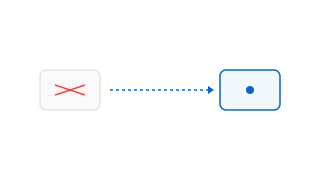
By default, every generic type parameter in Swift implicitly conforms to the Copyable protocol. This means the compiler assumes any generic type T can be copied at will. While this works for standard structures, classes, and collections, it prevents using generics with noncopyable types—structures configured with ~Copyable that represent unique system resources like file handles, database locks, or cryptographic keys.
To build generic containers (such as optional wrappers, result states, or custom collections) that can hold unique ownership resources, you must explicitly opt out of the implicit copyable constraint using the ~Copyable constraint syntax.
Declaring Generics with ~Copyable Constraints
When you define a generic type that can hold a noncopyable element, you apply ~Copyable to the generic parameter type definition.
Here is a generic Result wrapper designed to carry a noncopyable file handle resource or an error state:
import Foundation

// We relax the default Copyable constraint on the Success type parameter
enum UniqueResult<Success: ~Copyable, Failure: Error>: ~Copyable {
    case success(Success)
    case failure(Failure)
}

struct FileHandleResource: ~Copyable {
    private let fd: Int32

    init(fd: Int32) {
        self.fd = fd
    }

    deinit {
        // Developer Thoughts: Noncopyable types guarantee unique cleanup.
        // The file descriptor is closed when the resource falls out of scope.
        close(fd)
    }
}
Because UniqueResult holds a noncopyable element, the enum itself must be marked as ~Copyable. This prevents the container from being copied, ensuring that the wrapped unique resource remains single-owner.
Writing Extensions for Noncopyable Generics
When extending a generic type that has a relaxed ~Copyable constraint, the extension itself inherits that relaxation. You must specify the constraint on the extension block:
// We explicitly relax the constraint on the extension to work with noncopyable payload types
extension UniqueResult: ~Copyable where Success: ~Copyable {

    // Developer Thoughts: We use borrowing/consuming semantics to handle unique ownership.
    // consuming the result consumes the container, returning the owned success payload.
    consuming func get() throws -> Success {
        switch self {
        case .success(let resource):
            return resource // Ownership is transferred to the caller
        case .failure(let error):
            throw error
        }
    }
}
If you do not specify the ~Copyable constraint on the extension, the compiler will assume Success must be Copyable within that block, preventing you from calling methods on noncopyable variants of the generic type.
Summary
Generics over noncopyable types allow you to use Swift’s standard generic design patterns while maintaining strict compile-time ownership guarantees. This is particularly useful for systems-level resources where duplicate access could cause data corruption. Keep in mind that using ~Copyable requires careful management of borrowing and consuming accessors to ensure proper compiler verification.